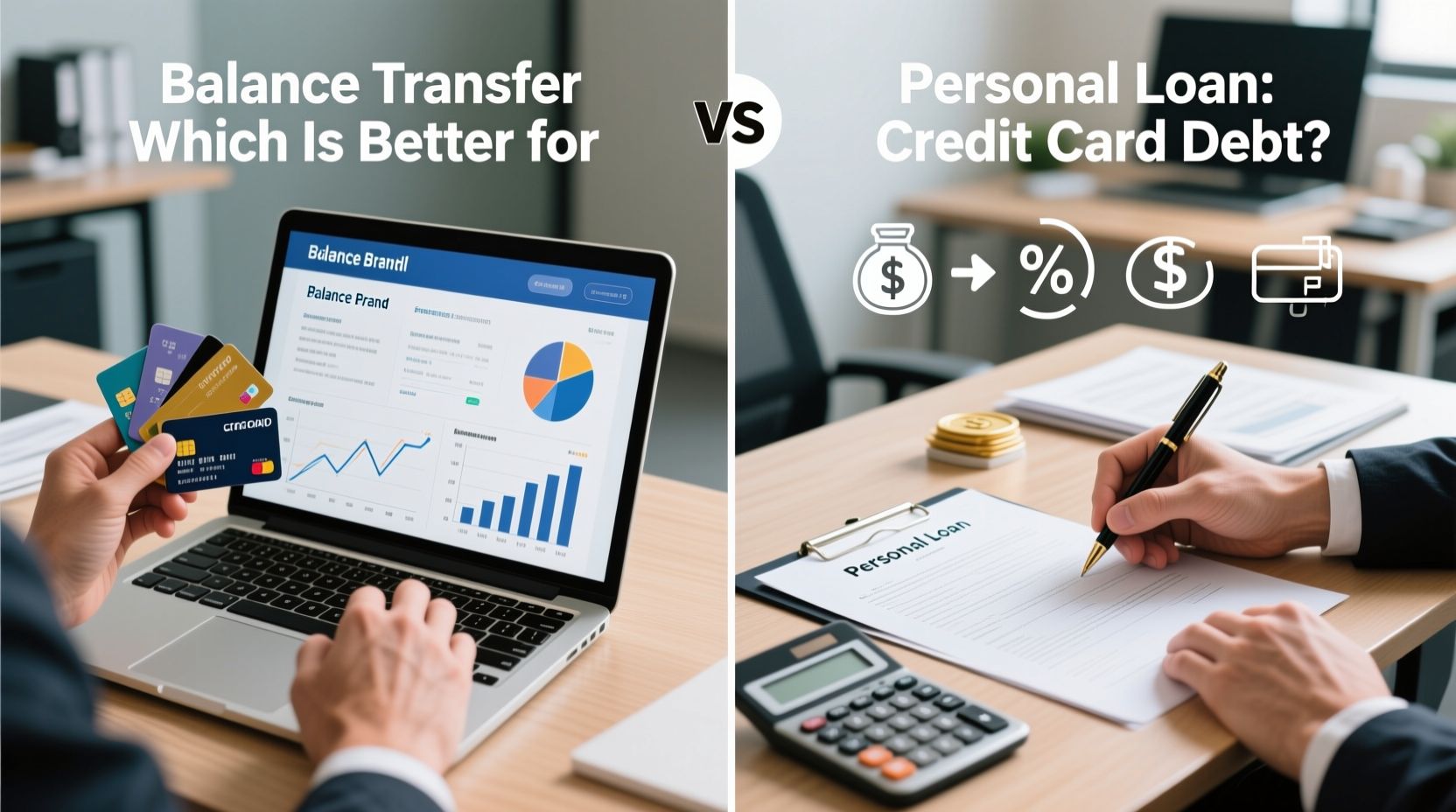
If you’re trying to consolidate credit card debt, the better choice usually comes down to timing and structure. A balance transfer can be the cheaper route if you qualify for a strong intro offer and can pay the balance down quickly; a personal loan is often safer when you want a fixed payment and a clear end date.
For more background on fixed-payment borrowing, see personal loans to consolidate debt.
Best fit at a glance
| If you need… | Balance transfer | Personal loan |
|---|---|---|
| Lower cost potential | Best if the promo APR lasts long enough and the transfer fee is modest | Can still be competitive, but usually not as low as a strong 0% offer |
| Predictable payments | Less predictable if you don’t finish before the promo ends | Fixed payment and fixed payoff date |
| Strong credit profile | Usually required for the best offers | Still important, but terms may be easier to compare up front |
| Longer payoff window | Riskier if the balance won’t be cleared in time | Usually better for larger balances or slower repayment |
How Each Option Works
A balance transfer moves existing credit card debt to a new card, usually to take advantage of a low or promotional APR. That can reduce interest quickly, but only if the transfer fee, credit limit, and promotional timeline all line up with your repayment plan.
A personal loan turns revolving credit card debt into an installment loan with one monthly payment. That structure often works better when you want certainty, especially if a short promo period would be too tight for your balance.

If you’re still comparing debt-consolidation routes, personal loans with low interest rates are worth reviewing alongside any card offer.
What Really Changes The Math
Balance transfer total cost
Transfer fee + any interest or fees that remain after the promo period ends
Personal loan total cost
Loan APR + origination fee, if charged by the lender
That’s why the headline APR alone is not enough. A low promotional rate can still cost more than expected if the balance transfer fee is high or if the payoff period is too short for the amount you owe. A personal loan can also become expensive if the APR is high or the monthly payment is stretched over a long term.
For a broader comparison of fixed-payment borrowing, the personal loan vs. personal line of credit article helps frame how structure changes the decision.
A Practical Decision Checklist
Use the same five checks before you choose either option.
- Credit Score And Approval Odds Are you likely to qualify for a competitive offer?
- Payoff Timeline Can you realistically eliminate the debt during a balance transfer promo period?
- Fees Will the balance transfer fee or loan origination fee change the outcome?
- Monthly Cash Flow Which payment fits your budget without creating new strain?
- Discipline Will you avoid adding new charges while you repay the balance?
If your budget is tight, it can help to revisit budgeting basics before you move debt around.
When A Balance Transfer Usually Wins
A balance transfer is often the better fit when all of these are true: you have solid credit, the transfer limit covers most or all of the balance, the fee is reasonable, and you can pay the debt down well before the promotional rate expires. In that case, the short-term savings can be meaningful.
- You want to attack interest costs aggressively.
- Your balance is small enough to clear within the promo window.
- You can stop using the old cards and avoid rebuilding the debt.
- Your offer terms beat what a personal loan would cost after fees.
For borrowers comparing consolidation options more broadly, personal loans as alternatives to payday loans is a useful adjacent read.
When A Personal Loan Is Usually Safer
A personal loan is often the better choice when the balance is too large for a short promo period, when you want a fixed repayment plan, or when you need the reassurance of a known payoff date. It’s also a strong option if you’d rather avoid the risk of carrying a leftover balance after a balance transfer promo expires.
- You want one payment instead of juggling several cards.
- You need a longer, more realistic repayment window.
- Your credit profile may not support the best balance transfer offers.
- You want a clearer path to becoming debt-free.
Where To Go Next
If you’re leaning toward a fixed-payment option, the most relevant next step is to compare lenders and terms before you apply. If you still think a balance transfer may work, make sure the payoff window and fee structure actually fit your balance.
Start with personal loans to consolidate debt and then review personal loans without origination fees if upfront costs are a concern.
Common Mistakes To Avoid
- Choosing the offer with the lowest teaser APR without checking fees.
- Assuming the balance will be gone before the promotional rate ends.
- Using the old credit card again after the transfer.
- Taking a personal loan payment that doesn’t fit your budget.
- Ignoring how your own repayment habits affect the outcome.
If your main concern is whether your credit profile is ready, read Should You Review Your Credit Score Now? and Crucial Credit Score Mistakes to Avoid.
Faqs
Is A Balance Transfer Always Cheaper Than A Personal Loan?
No. It can be cheaper only if the fee is reasonable and you repay the balance before the promotional APR ends.
Is A Personal Loan Better For Large Credit Card Balances?
Often, yes. Larger balances can be harder to clear during a short intro period, so fixed payments may be more realistic.
What Is The Biggest Risk With A Balance Transfer?
The biggest risk is carrying the remaining balance after the promo ends and paying a much higher rate than expected.
What Is The Biggest Advantage Of A Personal Loan?
The main advantage is repayment clarity: fixed payments, a fixed term, and a known payoff date.
Is It Better To Do A Balance Transfer Or Get A Personal Loan?
It depends on whether you can pay the debt off quickly enough to benefit from the promo period, or whether a fixed installment plan is the safer choice.

Jacob Harrison is a dynamic author specializing in a broad range of topics for QuickLoanPro. With a keen eye for detail and a passion for making financial concepts accessible, he helps readers navigate the complexities of personal finance, loans, and budgeting. Jacob’s insightful articles aim to empower individuals with the knowledge they need to make informed financial decisions, blending informative content with practical advice. Through his engaging writing style, he strives to connect with audiences, providing them with valuable resources for their financial journeys.



Your insights on the comparison between balance transfers and personal loans for consolidating credit card debt are incredibly relevant in today’s financial landscape. It’s fascinating how timing and structure play such a pivotal role in determining the best option for individuals facing this challenge.
I’m glad to hear you found the comparison between balance transfers and personal loans so relevant. It’s definitely a topic that can have a significant impact on people’s financial health. You mentioned the role of timing and structure, and that’s spot on. The best option really varies from person to person.
Thank you for your thoughtful comment! If you’re looking to explore more about these options and find the best fit for your situation, check out this resource for detailed insights and tips.
https://quickloanpro.com/payday-loan-solutions-chalmette-la
This is a really useful comparison, especially as it highlights the importance of timing and understanding our financial habits. I’ve personally found balance transfers to be a double-edged sword. While they can offer great savings, the pressure to pay off the debt before the promo ends can be intense. I once made the mistake of waiting too long, and the interest kicked in faster than I anticipated.
I can totally relate to that feeling of pressure when it comes to balance transfers. It can be a fine line between taking advantage of the savings and feeling overwhelmed by the ticking clock. Your experience really highlights how crucial it is to have a solid plan in place. I’ve found that creating a budget that clearly outlines my payments can take some of that pressure off. It just helps to see the numbers laid out, especially when the promo period is looming.