Payday Loan Interest Rate Limits Explained: Understanding Their Impact
Payday loan interest rate is the effective cost borrowers pay for very short-term, small-dollar advances. These products routinely use flat fees and finance charges that translate to extremely high annual percentage rates (APRs)—often in the hundreds of percent—so understanding rate limits and state rules is essential before borrowing.
What a “payday loan interest rate” really means
Payday loans are intended as very short-term advances, repaid on the borrower’s next paycheck. Lenders usually impose a flat fee or finance charge instead of monthly interest. When that fee is converted to an APR to compare with other credit, it often becomes very large—hundreds of percent—because the loan term is so short.
Authoritative coverage and consumer resources (Investopedia, consumer finance sites, and debt-relief organizations) show that payday loan fees commonly convert to APRs in the 391%–600% range, compared to typical credit card APRs of roughly 15%–30% or personal loans commonly in the low-to-mid double digits.
How fees convert to APR and why that matters
Lenders often charge a fixed fee for a short term. For example, a $15 fee on a $100 two-week loan looks small up front, but converting a two-week fee to an annualized APR yields a very high number. Calculating APR lets consumers compare payday fees to other credit types, and shows why even a modest flat fee can be costly when annualized.
State limits, enforcement, and variability
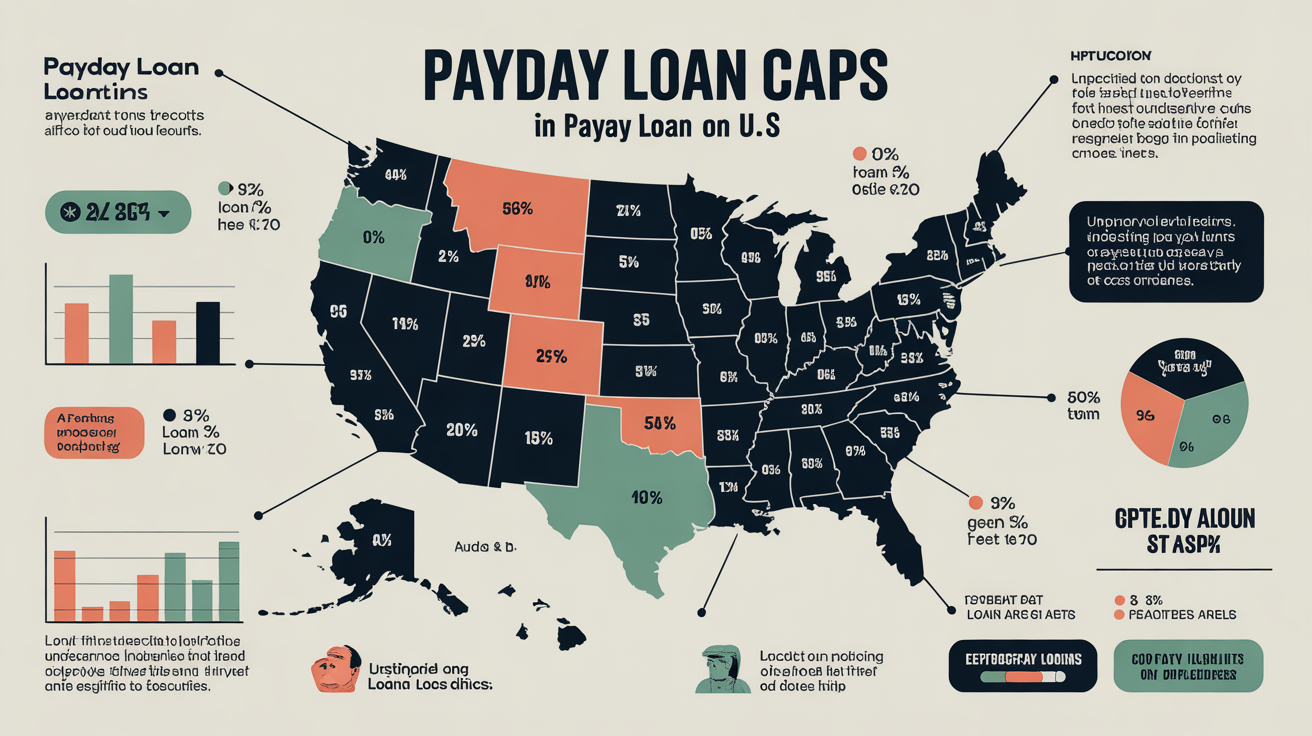
State law is the primary determinant of whether payday lenders may charge high fees. Some states cap short-term loan APRs (frequently at or near 36% APR) or restrict fees by loan amount; others have no effective cap and allow fees that translate to very high APRs. A few states have limited or effectively banned typical storefront payday lending.
That variability matters: in capped states borrowers face lower effective costs and less risk of rollover cycles; in uncapped states, fees can escalate and lead to repeated borrowing.
What the research supports
- Payday lenders often present flat fees rather than monthly interest; annualized, these fees produce extremely high APRs (hundreds of percent).
- Some states enforce caps (commonly 36% APR) or other restrictions; others allow much higher effective APRs or different fee structures.
- Regulatory differences mean the same loan terms can cost dramatically more or less depending on state law and enforcement.
Practical impact on borrowers

High effective APRs increase the chance a borrower cannot repay on time and must roll the loan forward or take a new payday advance to cover the previous one. That pattern — repeated short-term borrowing to cover principal and fees — drives higher overall costs and financial stress.
- Cycle of re-borrowing and mounting fees
- Damage to financial stability and budgeting
- Potential for default and collection action
- Lower cost of short-term credit
- Reduced likelihood of repeated borrowing
- Greater incentive to offer lower-cost alternatives
Alternatives to payday loans (facts to check before choosing)
When urgent cash is needed, consider options that research and consumer guides identify as lower-cost or more sustainable:
- Personal loans from banks or credit unions — generally much lower APRs but may require credit history and underwriting.
- Credit card cash advance (often lower APR than payday when spread over time, but fees and rates vary).
- Nonprofit small-dollar loan programs — many nonprofits offer affordable short-term loans and financial counseling.
- Borrowing from friends or family or arranging a payroll advance (if available) to avoid high fees.
Consumer resources and calculators can help estimate APR and total cost for a payday offer and for alternatives. Using a payday loan calculator shows how a single flat fee becomes a large APR when annualized.
What to check before taking a payday loan
- Ask for the fee expressed as an APR and confirm how long the loan term is.
- Check your state’s payday loan rules or caps — this determines whether the fee is legal and enforceable.
- Find out lender rollover, renewal, and collection policies (additional fees on renewals can raise total costs).
- Compare the payday offer to alternatives (credit union loan, personal loan, nonprofit lender) using a calculator.
- Read the contract for hidden fees and verify the lender is licensed in your state.
Regulatory context: federal and state roles

State law sets the principal limits for payday loan costs and licensing. Federal agencies such as the Consumer Financial Protection Bureau (CFPB) do not set a single national APR cap for payday loans but issue rules and guidance that aim to protect consumers (for example, around transparency and ability-to-repay assessments). In practice, consumers must check both state law and lender licensing.
Decision checklist: Is a payday loan the right choice?
- Have you compared the total cost (APR and fees) against alternatives?
- Can you repay the loan on the next paycheck without rolling or renewing?
- Is the lender licensed in your state and offering transparent APR-equivalent disclosures?
- Have you checked for nonprofit or credit-union alternatives that reduce cost and risk?
FAQ
How high can payday loan interest rates get?
When fees on very short-term loans are annualized, APRs commonly range from roughly 391% to 600% according to debt-relief and consumer sources. Exact numbers depend on the fee amount and the loan term.
Do federal rules cap payday loan APRs?
No single federal APR cap applies to all payday loans. Federal agencies (like the CFPB) issue protections and guidance, but state laws primarily determine allowable rates and licensing.
Where can I check my state’s payday loan rules?
State attorney general websites, your state’s consumer protection office, and official state banking or financial regulators publish licensing and rate-cap information. Consumer finance resources also summarize state-by-state rules.
Final takeaway
Payday loan interest rate calculations show these products are expensive when APR is used for comparison. State rate limits and licensing determine whether those fees are lawful. Before taking a payday loan, compare the APR-equivalent cost, confirm your state’s rules, and evaluate lower-cost alternatives such as credit-union small loans or nonprofit programs.
Sources: Investopedia (payday loan overview), debt-relief organizations and payday loan calculators for APR conversion examples and typical fee-to-APR ranges.
See also: Finance & Business.

Lindsey Moreau is a dedicated author and financial writer at QuickLoanPro, where she explores a range of general topics related to personal finance, lending, and money management. With a passion for making complex financial concepts accessible, she aims to empower readers with the knowledge they need to make informed decisions. Lindsey’s insightful articles are designed to engage and educate, reflecting her commitment to providing valuable resources for individuals seeking financial clarity.