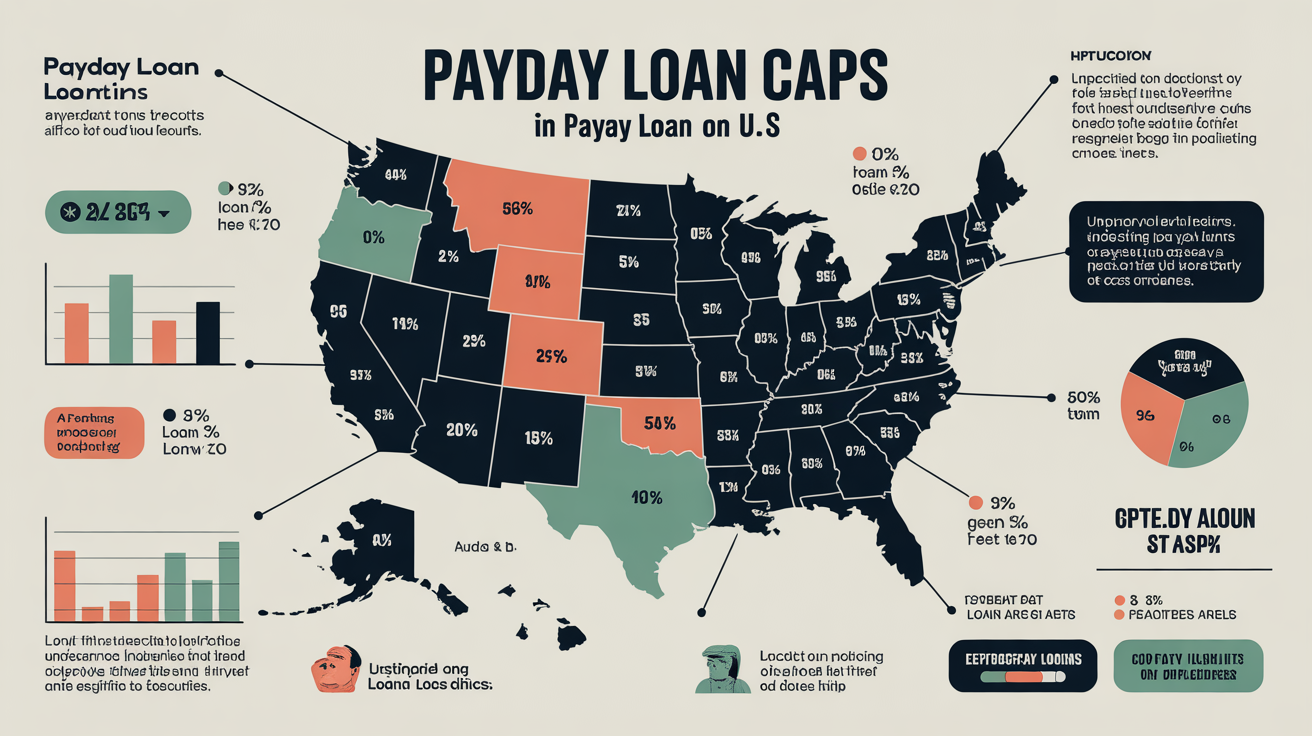
Payday Loan Caps In The Us Are Not Set By One National Rule. In practice, the limit depends on the state, the lender, and whether a federal law such as the Military Lending Act applies. If you want the broader regulations picture, start with QuickLoanPro’s payday loan stats overview and then compare the cap rules below.
How Payday Loan Caps Work In The Us
A payday loan cap usually refers to a legal limit on what a lender can charge or how a loan can be structured. Depending on where you live, that cap may cover the interest rate, a fee, the loan amount, a rollover, or all of the above. The important point is that payday lending in the United States is mostly governed at the state level, while federal rules step in for specific borrowers and specific lending situations.
That is why two borrowers with the same income can face very different offers. One state may ban payday lending outright, another may allow loans but restrict the APR sharply, and another may permit much higher pricing. For a state-by-state lens on the legal side of the market, see the 2025 payday loan laws guide.
At A Glance: Federal Rules Vs. State Caps
| Rule type | What it usually limits | Who it applies to | Why borrowers should care |
|---|---|---|---|
| Federal Disclosure Rules | How clearly the loan cost and terms must be shown | Most consumer lending, including payday-style products | Helps you compare APR, fees, and repayment timing |
| Military Lending Act | A 36% MAPR ceiling for covered loans | Active-duty service members and covered dependents | This is one of the clearest federal cost caps in the market |
| State Apr Or Fee Caps | Interest rate, fee limits, or both | Residents borrowing under that state’s law | This is usually the rule that changes the price the most |
| Loan-Size Caps | Maximum amount you can borrow | Borrowers in states that cap payday loan size | Helps prevent oversized loans that are hard to repay |
| Rollover Rules | Whether a loan can be renewed or extended repeatedly | Borrowers in states that limit rollovers or cool-off periods | Prevents debt from snowballing through repeated extensions |
Federal Protections You Should Know First
Federal law does not create one universal payday-loan cap across every state, but it does shape what lenders must disclose and, in some cases, what they can charge. That distinction matters because many readers assume the federal government sets a flat national APR limit for all payday loans. It does not.
Truth In Lending Act And Cost Disclosure
The Truth in Lending Act requires lenders to disclose key loan terms clearly, including the finance charge and the annual percentage rate. For payday loans, that transparency is essential because the dollar fee may look small at first glance while the annualized cost is extremely high. A borrower who only looks at the flat fee can easily miss the real cost of short-term borrowing.
If you are comparing multiple offers, disclosure is your first filter. A loan that advertises a manageable fee may still carry a very high APR once the repayment window is annualized. That is exactly why the disclosure rules matter: they make it possible to compare cost, not just loan size. For a deeper look at how those disclosures fit into the broader rule set, the CFPB regulations overview is the best companion page.
Military Lending Act Protections
The Military Lending Act is one of the clearest federal limits in this area. For covered loans, it places a 36% cap on the Military Annual Percentage Rate, which is a broader cost measure than APR because it can include certain fees. That means service members and covered dependents get a much firmer ceiling than many civilian payday borrowers do.
If you are in that category, the first question is not just whether a loan is available. It is whether the loan is covered and whether the lender’s total cost stays within the federal ceiling. That simple check can prevent an expensive mistake before the paperwork starts.
Cfpb Oversight And Why It Still Matters
The Consumer Financial Protection Bureau has played a major role in payday lending oversight through research, rulemaking, and enforcement. Its work has drawn attention to the risks of repeated borrowing, unaffordable repayment structures, and lending practices that fail to account for a borrower’s ability to repay. For consumers, that oversight matters because the CFPB’s actions influence how lenders present products and how regulators talk about affordability.
In practical terms, CFPB scrutiny has pushed the market toward clearer disclosures and stronger discussions around affordability. Even when a state allows payday loans, the broader federal conversation often shapes how lenders describe their products and how much attention consumers give to repayment risk.
State Caps Are Where The Real Differences Show Up
State law usually determines the practical answer to the question, “What are payday loans capped at?” Some states allow high-cost lending with loose restrictions. Others cap rates tightly, limit fees, cap the number of renewals, or ban payday loans altogether. Because of that patchwork, borrowers need to check the law in their own state rather than relying on a national headline number.
A state with no usable cap may make payday borrowing look fast and easy, but the long-term cost can be severe. A capped state may reduce access to short-term cash, yet it can also prevent the cycle of repeated refinancing that turns a small emergency into a long debt burden. If you want a broader map of where lending is restricted or prohibited, the payday loan bans by state article is the most direct follow-up.
Apr Caps
These limit the total price of borrowing, usually expressed as an annual percentage rate. They are the most visible way to stop a loan from becoming unmanageable.
Fee Caps
These limit origination charges, finance charges, or other fees layered on top of the loan. In payday lending, fee caps can matter just as much as the headline rate.
Rollover Limits
These restrict renewals or repeated extensions. Without them, borrowers can keep paying fees just to postpone repayment.
Loan-Size Caps
These set the maximum principal amount. Smaller loan caps can reduce risk, but the total cost still depends on how the lender prices the loan.
What Borrowers Should Check Before Signing
If you are deciding whether a payday loan makes sense, focus on the terms that change the actual cost and repayment pressure. The goal is not just to find out whether a lender is legal. The goal is to decide whether the loan can be repaid without creating a second financial problem.
- Check The Apr And The Fee Structure. The flat fee can hide a very expensive effective rate.
- Confirm The Loan Amount Limit. A bigger loan is not automatically better if repayment is already tight.
- Look For Rollover Or Renewal Restrictions. Repeated extensions are a major reason payday debt grows.
- Ask Whether Your State Imposes Caps Or Bans. State rules can completely change what is available.
- Compare A Cheaper Alternative First. Credit unions, installment loans, and emergency loan options may cost less overall.
That last point is especially important. A payday loan may solve a same-day problem, but it is often not the least risky option. If you are trying to bridge an emergency without stacking up extra cost, compare it against emergency loans and other short-term financing choices before you commit.
Borrowers who already know they may need repayment flexibility should also review alternatives to payday loans so they can compare costs before the due date arrives.
Want The Bigger Market Context?
This page is designed to help you understand caps and borrowing rules. If you want the wider regulatory and market context that sits behind those rules, the most useful next stop is the main payday loan stats and insights page.
For readers focused specifically on how regulators shape lender behavior, the CFPB overview is the most relevant companion article.
Common Borrower Questions About Caps
What Are Payday Loans Capped At?
There is no single national number. Payday loans may be capped by APR, fee amount, loan size, rollover frequency, or banned entirely, depending on the state and borrower type.
What Is The Highest Amount You Can Get On A Payday Loan?
The maximum amount depends on state law and lender policy. Some states set low principal caps, while others permit larger short-term loans, but larger amounts do not mean the loan is cheaper or safer.
How Many States Banned Payday Loans?
The number changes as laws evolve, so the safest way to check is through a current state-by-state guide. Some states ban payday lending outright, while others allow it with strict cost limits or product rules.
Can Banks Give You A $30,000 Loan Instead?
A bank loan, personal loan, or line of credit may offer a much larger amount than a payday loan, but approval depends on income, credit history, and underwriting. For many borrowers, a larger formal loan can be less expensive than repeating short-term payday borrowing.
What Is The 3-7-3 Rule?
The term is often used in lending discussions to describe a disclosure or timing pattern, but it is not a universal payday-loan cap. If you see it in an offer, read the disclosure carefully and confirm the repayment dates and fee timing.
Before You Borrow, Compare The Cap With The Real Cost
A legal loan is not automatically a good loan. The smartest move is to compare the APR, fee structure, repayment date, and rollover terms with a lower-cost option before you sign.
If you are reviewing this topic because you need a practical next step, start with the broader payday loan stats page, then move to the state-law guide that matches where you live.

Jacob Harrison is a dynamic author specializing in a broad range of topics for QuickLoanPro. With a keen eye for detail and a passion for making financial concepts accessible, he helps readers navigate the complexities of personal finance, loans, and budgeting. Jacob’s insightful articles aim to empower individuals with the knowledge they need to make informed financial decisions, blending informative content with practical advice. Through his engaging writing style, he strives to connect with audiences, providing them with valuable resources for their financial journeys.



You raise an important point about the role of federal regulations in shaping the payday loan landscape. The Truth in Lending Act (TILA) is indeed pivotal, not just for its requirement of clear disclosures but also for how it empowers consumers to make informed decisions. However, it’s worth considering the effectiveness of these regulations in practice.
You know, reading about the federal regulations on payday loans reminds me of the old days when I thought really high interest rates were just my credit card’s way of saying, “I love you.” Who knew that TILA was actually out there trying to play Cupid? In all seriousness, it’s so refreshing to see legal frameworks aiming for transparency in lending. It’s like the regulations are the adulting version of “do not talk to strangers.”
You’ve touched on a crucial aspect of consumer finance that affects so many people, yet the intricacies often remain obscured for borrowers. The discussion around payday loans and their regulation often raises more questions than answers, particularly regarding the balance between access to credit and protection from exploitation. I appreciate your insights into the Truth in Lending Act (TILA)—this legislation is indeed pivotal in ensuring that borrowers know what they’re signing up for.
It’s fascinating to see how federal regulations, like the Truth in Lending Act, play such a crucial role in shaping the payday loan landscape and protecting consumers. I think transparency is key in any lending practice, and it’s encouraging to see laws enforcing clear communication about loan terms and interests.
It’s fascinating to delve into the nuances of federal regulations surrounding payday loans, especially as they relate to the broader landscape of consumer finance. The Truth in Lending Act (TILA) is such a critical player in promoting transparency, and I often think about how vital this is for consumers who might be navigating financial difficulties.
It’s fascinating to consider how the regulatory framework surrounding payday loans not only impacts individual borrowers but also reflects larger societal values around financial fairness and consumer protection. The Truth in Lending Act (TILA) you mentioned is such a crucial piece in this puzzle—it emphasizes the importance of transparency in lending.
You raise some important points about the regulatory framework surrounding payday loans and its broader implications on society. It’s true that the Truth in Lending Act (TILA) serves as a vital tool for promoting transparency, which many people often overlook in discussions about financial products. By mandating lenders to disclose terms clearly, TILA aims to level the playing field for borrowers who often feel overwhelmed by the complexity of loan agreements.
I appreciate how you’ve laid out the complexity of payday loan regulations in such a clear and straightforward manner. It can be overwhelming to navigate this topic, given the various federal laws that interact with state regulations. The Truth in Lending Act (TILA) is especially interesting because it seems to walk a tightrope between providing necessary borrower protections and allowing lenders to operate in a way that keeps them afloat.
It’s encouraging to hear that you found the complexities surrounding payday loan regulations articulated clearly. The interplay between federal and state laws can indeed feel daunting, and it’s a topic that affects so many people in different ways.
Thank you for your thoughtful insight! If you’re interested in delving deeper into the interplay of federal and state regulations surrounding payday loans, I invite you to explore this resource that provides even more clarity on the subject.
https://quickloanpro.com/payday-loans-laplace-la
I appreciate your thoughts on the complexities of payday loan regulations. It really is a tangled web, especially when you consider how state laws can vary dramatically from one region to another. The impacts on individuals can be quite profound, particularly for those who might be in a vulnerable financial position.
It’s intriguing to dive into the complexities of payday loan regulations, especially given how rapidly the landscape can change. I remember reading about how certain states have implemented stricter laws to protect borrowers, which can really make a difference in consumer experience. It’s a delicate balance between providing quick access to cash and ensuring that lenders uphold ethical practices.
Navigating the intricacies of payday loans is undoubtedly a daunting task, especially given the potential for financial strain if one isn’t fully informed. The emphasis on understanding federal regulations is particularly crucial, as these laws not only aim to protect consumers but also to promote transparency in an often murky lending landscape.
It’s insightful to see the emphasis on understanding payday loan regulations, as many consumers often overlook the potential pitfalls. However, while federal regulations attempt to create a safety net, they vary significantly by state and can sometimes still allow for exploitative practices to occur. For example, borrowers may be enticed by quick access to cash, only to find themselves trapped in a cycle of debt due to high-interest rates and fees.
The varying payday loan caps across states indeed highlight a significant challenge for borrowers seeking to navigate these financial waters. It’s intriguing how local regulations can create such a patchwork of rules, which complicates not only the decision-making process for consumers but also the way lenders operate.
It’s interesting how the variability of payday loan caps reflects not only regional economic conditions but also local attitudes toward consumer protection. In many states, the absence of a federal cap allows lenders to exploit vulnerable borrowers, often leading to a cycle of debt that impacts broader economic stability. For instance, states with more stringent regulations often report better financial health among their residents, suggesting that tighter controls could lead to improved outcomes for consumers.
It’s really interesting to see how payday loan caps in the U.S. can vary so wildly depending on where you are. I remember when I was living in Ohio for a bit, I was shocked at the interest rates some lenders were charging. It felt like a different world compared to some of the more regulated states. The nuances you pointed out about the APR, fees, and rollover rules are basically vital for anyone thinking of entering the payday loan space.
Your insights into the complexity of payday loan caps across different states really highlight an often-overlooked issue. It raises important questions about how financial regulations can vary so dramatically, impacting those who are already in vulnerable positions. Each state seemingly has its own approach, but I wonder if the lack of a national standard contributes to the confusion for borrowers trying to make informed decisions.