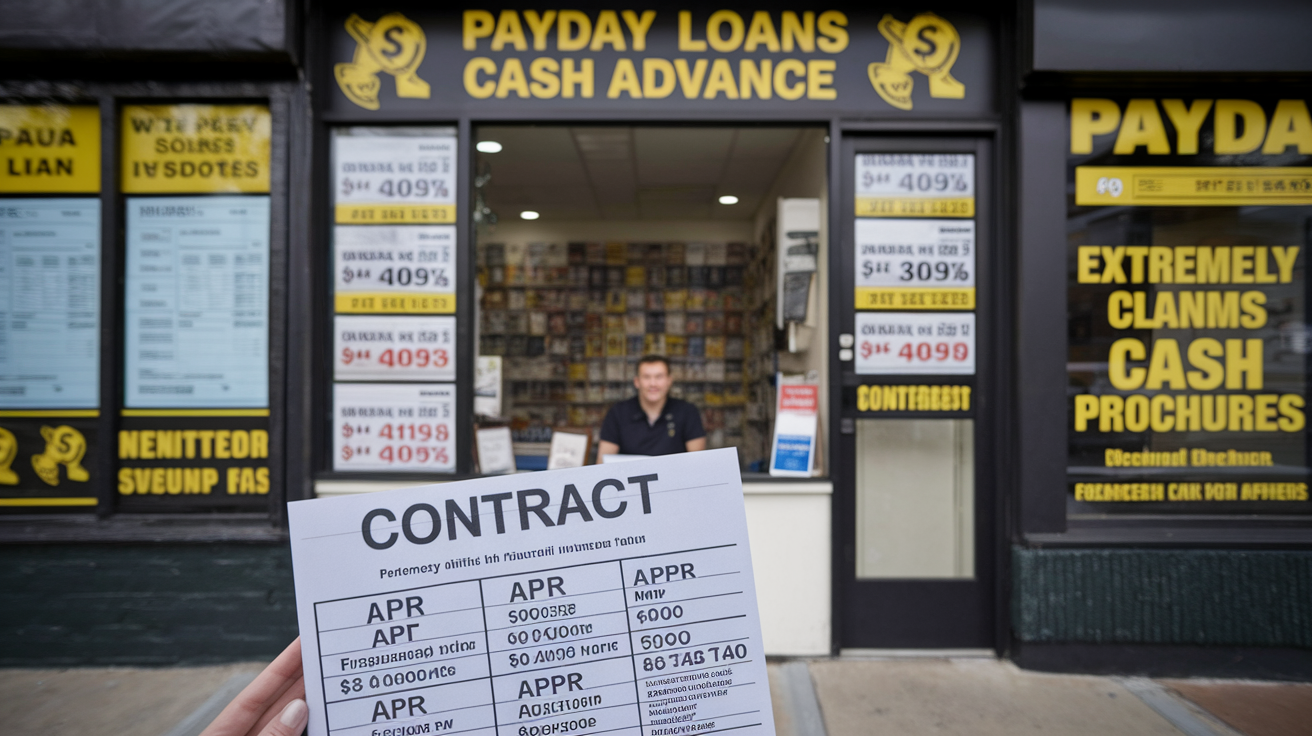
Payday loans look small on paper, but their pricing can become expensive very quickly. The main reasons are short repayment windows, fixed fees that work like very high APRs, and state laws that allow widely different pricing models.
Quick Take payday loan rates are high because lenders charge a flat fee for a very short loan term, then annualize that cost into an APR that can reach triple digits. If you want to see how that math works on an actual loan amount, start with this cost guide while you read.
- The fee structure, not just the headline loan amount, drives the true cost.
- Borrowers usually have little time to repay, so the annualized rate looks extreme.
- State laws can cap fees, restrict rollovers, or leave lenders with broad pricing room.
- Lower-cost alternatives are often available if you can qualify for them.
Why The Price Gets So High So Fast
The simplest way to understand payday loan pricing is to separate the fee from the APR. A payday lender may advertise a fixed dollar fee, such as $15 for every $100 borrowed, but the loan is usually due in about two weeks. That short term makes the annualized cost look enormous even when the dollar fee seems modest at first glance.
This is why many borrowers are surprised by the true cost. The loan is priced for speed and convenience, not for long-term affordability. The lender expects repayment in one lump sum, not over many months, and that structure pushes the effective APR far above a typical bank loan or credit union personal loan.
| Cost driver | How it affects the price | Why it matters |
|---|---|---|
| Flat Lender Fee | A fixed charge per $100 borrowed | Looks small, but it compounds into a very high annualized rate |
| Short Repayment Term | Often due on the next payday | The shorter the term, the higher the APR looks when annualized |
| State Rules | Caps, disclosures, rollover limits, or lighter regulation | Pricing can change dramatically from one state to another |
| Borrower Risk | Limited underwriting and higher default risk | Lenders price in the chance that some loans will not be repaid on time |
Apr, Fees, And The Real Cost Of Borrowing
APR is the best common language for comparing loans, but with payday loans it can also be misleading if you read it too quickly. The reason is that APR spreads the cost of a short-term loan over a full year. If a lender charges a fee for two weeks of borrowing, that fee can translate into a startling annual rate once it is annualized.
That does not mean every borrower keeps the loan for a year. It means the cost of borrowing for a very short period is being expressed on a yearly scale. For borrowers, the more practical question is not only “What is the APR?” but also “What will I pay on my next paycheck date, and can I afford that without borrowing again?”
A useful next step is to calculate the total dollar cost before accepting the loan. The numbers matter more than the marketing language, which is why a cost breakdown by loan amount is often more helpful than a headline rate alone.
What Pushes Apr So High?
- Short Terms a fee charged over 14 days looks much larger when converted to a yearly rate.
- Front-Loaded Fees the cost is often due immediately or at repayment, not spread out over time.
- Limited Competition On Terms some borrowers compare speed rather than full cost, giving lenders pricing power.
- Higher Default Risk lenders factor in the likelihood of missed payments and repeat borrowing.
Why State Law Matters So Much
Payday loans are not priced the same way across the United States. State law shapes the loan market more than many borrowers realize. Some states set strict caps on fees or outright limit payday lending, while others allow lenders more room to charge higher fees, extend repayment structures, or operate with fewer restrictions.
That patchwork creates a major difference in what borrowers actually see at checkout. Two people can borrow similar amounts in different states and receive very different loan terms. If you want the state-level view, the most direct companion piece is our guide to payday loan laws in 2025, which explains how rules vary and why that changes the effective cost.
In Practice, State Rules Affect Three Things Most
- the maximum fee or rate a lender can charge,
- whether loans can be rolled over or renewed, and
- how clearly lenders must disclose the total cost.
A Quick Timing Note On When Costs Become Worst
The cost is often highest when the borrower cannot repay on the next payday and has to renew, roll over, or stack another loan. That is where a short-term fee turns into a longer-term debt problem. Even if the initial loan was meant to cover one emergency, the real cost rises quickly once the balance stretches beyond the original paycheck cycle.
Why Lenders Price For Risk, Not Generosity
A payday lender is usually making a short, unsecured loan to a borrower who may not qualify for a bank loan, has limited savings, or needs cash before the next payday. That profile increases the chance that the loan will be repaid late or not at all. To offset that risk, lenders charge more upfront.
This risk-based pricing explains why the industry often uses fixed fees instead of traditional interest schedules. It also explains why lenders keep terms short: the business model depends on fast repayment and repeated turnover. The result is expensive borrowing for the consumer, especially if the loan is used as a recurring fix instead of a one-time bridge.
For readers who want to see how those costs compare across products, the cleanest next step is to compare a payday loan with a lower-cost installment option or personal loan. A useful place to start is personal loans with low interest rates, especially if you can qualify for a more predictable monthly payment.
What To Compare Before You Borrow
If a payday loan is still on the table, compare the loan using the same questions lenders would use to make their pitch less confusing. This is the part that prevents the APR from becoming a surprise after the money is already in your account.
- Total Dollar Fee the amount you pay above the principal.
- Due Date whether repayment falls on the next payday or a later date.
- Renewal Rules whether the loan can be rolled over and what that costs.
- State Restrictions local caps, disclosures, and borrower protections.
- Lower-Cost Alternative a personal loan, credit union product, or other option with more manageable repayment.
If you are comparing several borrowing options, it can help to read a broader alternatives overview as well. Our page on the best payday loan alternatives in the US for 2025 is a good companion when you are deciding whether to borrow at all.
If You Are Already Weighing A Payday Loan, Compare The Cost Before Signing.
The fastest way to avoid overpaying is to calculate the total fee, check your state’s rules, and then compare the loan with a lower-interest option that gives you more time to repay.
Start with the cost math, then review state regulations, and if you can qualify, look at lower-interest personal loans before making a final decision.
When A Payday Loan Is Most Likely To Become Expensive
The original loan is often not the real problem; the repeat use is. A payday loan becomes far more expensive when the borrower cannot repay the principal plus fee on time and starts using another advance to cover the first one. At that point, the short-term product starts behaving like an ongoing debt burden.
That cycle is why many consumer advocates focus on fees, rollovers, and disclosures together. If the lender’s structure encourages repeated borrowing, the annualized cost rises dramatically and the borrower may end up paying far more than expected. This is also why some people later need help repairing their broader finances; if that is your situation, our article on how payday loans affect personal finances offers a more practical next-step view.
Where The Federal Role Fits In
Federal oversight matters, but it does not create one uniform national payday loan price. The Consumer Financial Protection Bureau has influenced disclosure and consumer-protection expectations, yet much of the actual rate setting still happens at the state level. That is why regulation looks inconsistent from one market to another.
The practical result is a lending landscape where the same basic product can feel regulated, restricted, or nearly unrestricted depending on where you live. If you want a deeper look at the policy side, the 2025 state law guide is the most relevant companion piece to this article.
Common Questions About Payday Loan Rates
Many borrowers ask whether the rate is “legal” simply because it is high. The answer depends on the state and the exact loan structure. A lender may be complying with local law while still charging a price that is expensive in practical terms. That is why it helps to look at both the legal rule and the total repayment amount before borrowing.
Another common question is whether the lender is really charging interest or just a fee. In payday lending, the fee usually functions like interest because it is the cost of using the money for a very short time. Once that cost is annualized, the effective rate can appear shockingly high even though the cash charge is fixed.
Frequently Asked Questions

Jacob Harrison is a dynamic author specializing in a broad range of topics for QuickLoanPro. With a keen eye for detail and a passion for making financial concepts accessible, he helps readers navigate the complexities of personal finance, loans, and budgeting. Jacob’s insightful articles aim to empower individuals with the knowledge they need to make informed financial decisions, blending informative content with practical advice. Through his engaging writing style, he strives to connect with audiences, providing them with valuable resources for their financial journeys.



The regulation of the payday loan industry is indeed a crucial topic, and it’s fascinating to see how the dynamics vary from state to state. While the CFPB plays a vital role in establishing some level of consumer protection, the state-specific laws create a patchwork system that can be quite confusing for borrowers. This begs the question: how effectively can a federal agency like the CFPB oversee an industry that is so deeply interwoven with state law variations?
You’ve touched on a critical aspect of financial literacy and consumer protection that often gets overshadowed by the immediacy of payday loans’ appeal. While it’s true that the Consumer Financial Protection Bureau (CFPB) plays an essential role in oversight, the patchwork of state regulations really highlights the complexities of the issue.
Ah, payday loans—the financial equivalent of trying to quench your thirst with saltwater! It’s fascinating how regulation can be a double-edged sword in this industry. The CFPB does serve as a much-needed lifebuoy for consumers, but I often wonder how effective it truly is. With every state having its own laws, it’s like a game of Monopoly where the rules change depending on which hotel you’re landing on.
Ah, the world of payday loans—a topic that feels like a live demonstration of that old circus adage: “Step right up and see the amazing high-interest loans!” It’s fascinating (and a bit maddening) to see how state laws create such a patchwork of regulations, where your luck at finding fair terms can hinge entirely on your ZIP code.
I really appreciate how you highlighted the role of the Consumer Financial Protection Bureau (CFPB) in regulating the payday loan industry. It’s interesting to think about how federal oversight can vary such dramatically when you consider state laws—especially since regulations can often be a bit of a double-edged sword. In some states with looser regulations, as you pointed out, competition ends up driving interest rates higher, which is counterintuitive to what one might expect.
Navigating the complexities of payday loans is indeed crucial for anyone considering this option. The high-interest rates can often trap borrowers in a cycle of debt, making it essential to fully understand the terms involved before signing any agreement.
Your analysis of payday loans really highlights the often-overlooked complexities of their pricing structure. It’s intriguing how the flat fee model can lead to such exorbitant APRs when annualized, creating an almost deceptive appearance of affordability.
It’s interesting to see how payday loans can often be misleading at first glance. On paper, they appear to be a quick fix for financial stress, but as you pointed out, the underlying costs can spiral out of control. I remember when a friend of mine turned to a payday loan in a pinch. They needed a couple of hundred bucks to cover an emergency car repair. Initially, the loan seemed like a lifeline, but the repayment terms were brutal. They had to pay back significantly more within just two weeks, and by the time they got to the end of that term, they found themselves trapped in a cycle of borrowing and repaying.