Payday Loan Regulations: Federal Rules, State Laws, and Borrower Protections
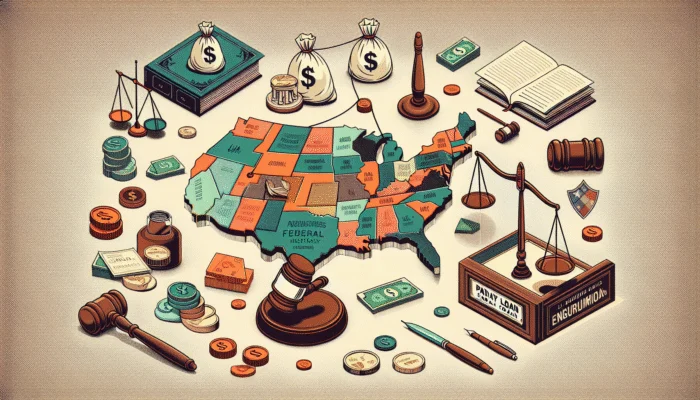
Payday loan regulation in the United States is a layered system of federal consumer-protection rules and state-specific lending laws. Federal law can govern disclosures, electronic payments, certain collection practices, and other consumer protections, while state law often determines whether a payday product is permitted and may regulate licensing, fees, loan amounts, repayment terms, renewals, and other conditions.
Do not rely on a national article to tell you the exact legal limit for a payday loan in your state. First identify the lender and product, then check the current state regulator or attorney general, and finally compare the written loan terms with any federal protections that apply to that transaction.
How Payday Loan Regulation Works
Federal and state rules perform different jobs. Federal consumer-finance laws create protections that can apply across states when their coverage requirements are met. State law controls much of the product-level detail and can determine whether a lender may offer a particular form of payday credit in that jurisdiction.
| Layer | What it may address | What the borrower should verify |
|---|---|---|
| Federal law | Credit disclosures, electronic-payment rights, certain payment-transfer rules, and debt-collection protections where applicable | Which federal rule actually covers the product, lender, payment method, or collector involved |
| State law | Whether the product is permitted, licensing, pricing or fee limits, loan amounts, terms, renewals, repayment plans, and other protections | Current statute and regulator guidance for the state where the loan is made |
| Enforcement | Federal agencies, state financial regulators, attorneys general, courts, and other authorities depending on the issue | Which agency handles the specific complaint or licensing question |
This framework is why two loans marketed with similar language can be treated differently in different states. Legal classification depends on the actual product structure and current law, not merely on whether a company calls the product a “payday loan,” “cash advance,” or another marketing term.
Federal Rules: What Borrowers Should Know
Federal rules do not make payday lending uniform nationwide, but several federal consumer protections can matter depending on the loan and the party involved.
APR and cost disclosures
Regulation Z implements the Truth in Lending Act for consumer credit. CFPB consumer guidance states that a payday lender must disclose the annual percentage rate (APR) and other loan costs before the borrower agrees to the loan. APR is useful because it expresses the cost of credit as an annualized rate and makes it easier to compare differently structured credit products.
CFPB — APR and payday loan disclosures

The CFPB Payday Lending Rule and payment transfers
The current CFPB Payday Lending Rule, 12 CFR Part 1041, covers specified payday, vehicle-title, balloon-payment, and certain higher-cost longer-term loans. Its current operative provisions focus heavily on payment transfers from consumer accounts.
For a covered loan, the rule generally prohibits a lender from initiating another payment transfer after two consecutive failed payment transfers from the consumer’s account unless the lender obtains a new and specific authorization or another rule exception applies.
The CFPB revoked the Payday Lending Rule’s mandatory underwriting provisions in 2020. Do not treat the current federal rule as imposing a universal CFPB ability-to-repay requirement on every payday loan.
The payment provisions became operative on March 30, 2025. On March 28, 2025, however, the CFPB announced that it would not prioritize supervision or enforcement actions for penalties or fines associated with the Payment Withdrawal and Payment Disclosure provisions and said it was considering narrowing the rule. That enforcement-priority statement did not itself rewrite the regulation, so current official CFPB materials should be checked for later changes.
Official references:
CFPB — Payday loan protections
CFPB — Current 12 CFR Part 1041
CFPB — March 28, 2025 enforcement statement
Electronic payment authorization
Payday loans often involve a post-dated check or electronic access to a bank, credit-union, or prepaid-card account. CFPB guidance explains that federal law does not allow a lender to condition the extension of credit on the consumer preauthorizing recurring electronic fund transfers.
A consumer can also revoke authorization for automatic electronic debits. Revoking an automatic payment authorization does not cancel the underlying debt; it changes how the lender may obtain payment.
CFPB — Stopping automatic payday-loan debits
Debt collection rules
If a payday debt is being collected by a third-party debt collector or another party covered by the Fair Debt Collection Practices Act and Regulation F, federal debt-collection restrictions may apply. The FDCPA generally does not cover collection by the original creditor itself, although state law and other federal consumer-protection rules may still matter.
What Payday Loan Rules Can Vary by State?
State law can change the practical availability, cost, structure, and enforcement of payday lending. Because these rules change and product definitions differ, a national guide should describe the regulated dimensions rather than publish an unmaintained 50-state table of legal conclusions.
A state may permit payday lending, restrict it through other lending laws, or make the traditional product unavailable under current state rules.
States that permit a product may require the lender to hold a license or registration before offering it to residents.
State law may regulate finance charges, fees, rates, or other components of the cost of credit.
Some states limit the amount available under a payday-loan or small-dollar-credit statute.
Minimum or maximum repayment periods can depend on state law and on how the product is legally classified.
A state may prohibit, limit, or condition extensions and repeat borrowing.
Some jurisdictions may require or permit extended repayment arrangements under defined conditions.
Complaint procedures, penalties, and available remedies depend on the governing statute and the facts of the transaction.
CFPB consumer guidance recommends checking a payday lender’s licensing status with the state regulator or state attorney general. An absent license can have different legal consequences in different jurisdictions, so do not assume that a database search alone determines whether a debt is void or unenforceable.
How to Check a Payday Loan Before You Sign
A borrower should verify both the provider and the specific loan terms. A lender can operate lawfully in one state or under one product structure and face different requirements elsewhere.

- ☐ Identify the lender’s legal business name.
- ☐ Check the state regulator or attorney general for current licensing and payday-lending rules.
- ☐ Confirm how much money you will actually receive.
- ☐ Review the finance charge and APR.
- ☐ Record the exact due date or payment schedule.
- ☐ Understand whether repayment uses a check, ACH authorization, debit card, or another method.
- ☐ Read what the agreement says about failed payments, returned items, late charges, or NSF-related costs.
- ☐ Check whether renewals, rollovers, or repayment plans are permitted under the applicable rules.
- ☐ Save the disclosures, agreement, payment authorization, receipts, and lender communications.
- ☐ Do not rely on a salesperson’s oral explanation when the written agreement says something different.
What to Do if You Think a Payday Lender Broke a Rule
Start by preserving evidence. Save the agreement, disclosures, account statements, screenshots, payment records, emails, text messages, and notes from phone calls. Then identify whether the problem concerns licensing, loan terms, electronic payments, collection conduct, advertising, or another issue.
- Contact the lender or servicer in writing when a billing, payment, or account issue may be corrected directly.
- Contact the state financial regulator or attorney general for state licensing and payday-loan-law questions.
- Submit a complaint to the CFPB for covered consumer-finance problems.
- Report suspected fraud or deceptive conduct to the FTC where appropriate.
- Consider legal aid or a qualified attorney when you need advice about a specific contract, lawsuit, remedy, or state-law right.
Submit a consumer-finance complaint
ReportFraud.ftc.gov
Filing a complaint does not automatically mean a loan is void, that money will be refunded, or that a regulator will reach a particular result. Those outcomes depend on the facts and applicable law.
Why a National Payday Loan Regulation Guide Has Limits
Payday-loan statutes are unusually dependent on jurisdiction and product definition. A state may change a fee limit, licensing rule, renewal restriction, or even the category under which a product is regulated. Online lending can add another layer because the lender, borrower, lead generator, and servicing company may be located in different places.
For that reason, this page intentionally does not publish a supposedly permanent list of state APR caps, maximum loan amounts, ban status, or rollover limits. Those figures should be checked against current official state sources when the answer matters to a real transaction.
Identify the legal entity → identify the product structure → identify the borrower’s state → check the current state regulator or statute → review the federal rules that apply to that transaction.
Payday Loan Rules Can Change
Payday regulation should be treated as current-law information, not as a permanent set of numbers. Federal rules can be amended, courts can affect implementation, agencies can change enforcement priorities, and states can revise lending statutes or licensing requirements.
The current federal example shows why dates matter: the CFPB’s payment provisions became operative in March 2025, while the Bureau simultaneously announced a different enforcement priority and continued to publish the current regulation and compliance resources afterward.

When a rule affects whether you should sign, pay, dispute, or litigate a specific loan, confirm the current official source rather than relying only on an older article or archived state table.
Already Have a Payday Loan You Cannot Repay?
Regulation research and debt-resolution guidance are separate tasks. If the loan is already outstanding and repayment is becoming difficult, use QuickLoanPro’s separate guide to
payday loan debt, repayment, and relief options
rather than taking another short-term loan simply to cover the first one.
Payday Loan Regulation FAQ
Are payday loans regulated by the federal government or by states?
Both can matter. Federal consumer-protection laws may govern disclosures, payment practices, debt collection, and other areas when their coverage requirements are met. State law often determines whether the product is permitted and may set licensing, pricing, loan-amount, term, renewal, and other requirements.
Does the CFPB require payday lenders to determine ability to repay?
Do not rely on the original 2017 rule for that conclusion. The CFPB revoked the rule’s mandatory underwriting provisions in 2020. The current Part 1041 framework retains payment-related provisions for covered loans.
What happens after two failed payday-loan payment attempts?
Under the current CFPB Payday Lending Rule, a lender generally cannot initiate another payment transfer from the consumer’s account in connection with a covered loan after two consecutive failed payment transfers unless it obtains new and specific authorization or another applicable rule provision permits the transfer.
How do I know whether a payday lender is licensed?
CFPB guidance recommends verifying the lender with your state regulator or state attorney general. Use the lender’s legal company name rather than relying only on a brand name or website domain.
Are payday loan laws the same in every state?
No. States can differ on whether payday lending is permitted, licensing, costs, loan amounts, repayment periods, renewals, repayment plans, and other protections. Exact current limits should be checked with an official state source.
Does the FDCPA apply directly to every payday lender?
No. The FDCPA and Regulation F govern covered debt collectors and generally do not apply to collection by the original creditor itself. State debt-collection laws and other consumer-protection rules may have different coverage.
Can I revoke automatic electronic payments to a payday lender?
CFPB guidance says consumers can revoke authorization for automatic electronic debits. Revoking the authorization does not cancel the loan balance or the obligation to repay under the contract.
Primary sources used: Consumer Financial Protection Bureau regulations and consumer guidance, including 12 CFR Parts 1026, 1041 and 1006, plus current CFPB complaint and payday-loan resources.
Important: This article provides general consumer-finance education and is not individualized legal or financial advice. Payday-loan legality, licensing, fees, remedies, repayment rights, and enforcement can depend on the state, the lender, the product structure, and the facts of the transaction. Verify current requirements with the appropriate regulator or qualified legal professional when a specific legal outcome matters.

Lindsey Moreau is a dedicated author and financial writer at QuickLoanPro, where she explores a range of general topics related to personal finance, lending, and money management. With a passion for making complex financial concepts accessible, she aims to empower readers with the knowledge they need to make informed decisions. Lindsey’s insightful articles are designed to engage and educate, reflecting her commitment to providing valuable resources for individuals seeking financial clarity.



Your assessment of payday loan regulations highlights the complexities that both consumers and lenders must navigate in this often contentious space. The different frameworks at both federal and state levels create an environment where access to credit can fluctuate dramatically depending on where one resides. This disparity raises several pertinent issues regarding financial literacy and borrower protections.
Your exploration of payday loan regulations really resonates with the complexities many face today. It’s fascinating how the regulatory landscape varies so widely across the country, reflecting not just distinct economic conditions but also differing cultural attitudes towards borrowing and lending.
Navigating the complexities of payday loan regulations certainly brings to light the challenges many consumers face. The implications of TILA are significant, as it strives to enhance transparency in lending. However, the effectiveness of these disclosures largely depends on borrowers’ financial literacy. Many individuals may struggle to fully understand the terms despite clear wording.
You’ve hit the nail on the head with that observation about financial literacy! It’s like handing someone a complicated IKEA manual and then getting upset when they can’t piece together a bookshelf. The clarity of regulations is one thing, but if folks don’t understand the fine print, they might as well be reading it in Swahili.
“To help improve financial literacy and empower consumers, check out this resource that breaks down loan terms in an easy-to-understand format.”
https://quickloanpro.com/payday-loans-westwego-la
Your exploration of the complexities surrounding payday loan regulations presents an important opportunity to reflect more critically on the ramifications for borrowers and the broader financial landscape. Many people view payday loans as a quick fix in times of financial distress; however, as your post indicates, a deeper understanding of the regulatory limitations and consequences is crucial for making informed decisions.