Payday loans can hit minority communities harder because access gaps, lower local banking options, and tighter cash flow often leave borrowers with fewer safe choices. The real issue is not just the loan itself, but how quickly its fees, timing, and repayment pressure can deepen financial strain.
Quick take
If you are weighing a payday loan, the biggest risk is getting pushed into a repeat-borrowing cycle before you can recover. For safer next steps, start with the broader best alternatives to payday loans and, if you are already juggling debt, review repayment tips before borrowing again.
Why Payday Loans Are Riskier In Minority Communities
The minority-equity question is not only whether payday loans are expensive; it is whether the local financial environment leaves people with fewer escape routes. In many communities, payday lenders are easier to find than banks, while wages, household savings, and access to affordable credit are all more limited. That combination makes the same loan far more damaging.
What makes the impact unequal
- Higher likelihood of living in areas with fewer bank branches and more alternative lenders.
- Greater odds of needing cash for urgent bills without emergency savings to absorb the hit.
- More exposure to repeated borrowing when the first loan does not solve the original problem.
- More damage from overdraft fees, late fees, and missed payments when cash flow is already tight.
How Payday Lending Shows Up In Minority Neighborhoods
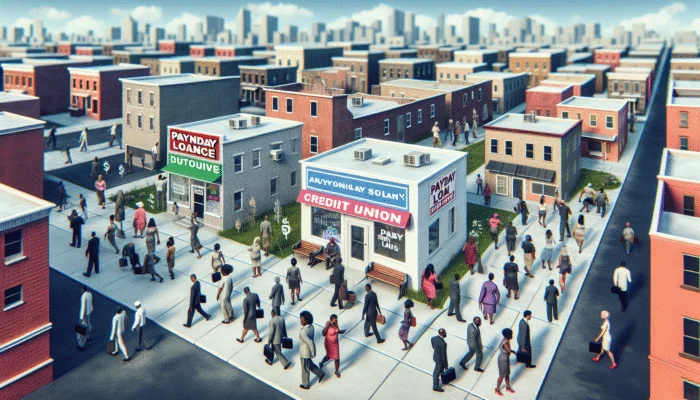
Payday lenders often cluster where financial alternatives are thin. That concentration matters because people usually shop for emergency cash close to home, during limited hours, and under stress. If the nearest choices are only high-cost lenders, the market is not really a free comparison at all. It is a constrained decision shaped by geography, income, and time pressure.
This is why the same loan can look like a small temporary fix on paper but become a long-term burden in practice. In minority communities, the borrowing decision is often tied to rent, utilities, transportation, or medical costs that cannot be delayed. Once those bills stack up, the lender’s short repayment window can force a borrower to extend, roll over, or refinance the debt under worse terms.

The Credit And Household Costs That Follow
The biggest financial harm is usually not the first fee. It is the chain reaction that starts when a borrower cannot repay on schedule. Payday loans can drain the next paycheck before essential expenses are covered, which increases the odds of overdrafts, missed rent, late utility bills, and reliance on another high-cost loan.
That pressure can show up in several ways:
- Bank-account strain from automatic withdrawals or check cashing delays.
- Higher total debt after fees, renewals, and repeated borrowing.
- Weaker credit standing when missed payments or defaults appear in a borrower’s record.
- Reduced room to save, which makes the next emergency more likely to trigger another loan.
If the main concern is rebuilding after a payday loan, the more relevant next read is how payday loans affect credit and recovery steps. That angle is better for people who already borrowed and need a repair plan, while this article focuses on the minority equity lens and the decision to borrow in the first place.
What Safer Options Usually Work Better
Safer alternatives are not one-size-fits-all, but the right choice usually gives you more time, lower fees, and less risk of rollover debt. That is the basic standard to use before agreeing to any emergency loan.
Credit Unions And Community Lenders
These lenders may offer smaller-dollar loans, lower rates, and more flexible repayment schedules. They are often the closest match for borrowers who need short-term help but want to avoid a payday rollover cycle.
Installment Or Personal Loans
A small personal loan can still be expensive, but it is often easier to manage than a loan due in a single paycheck. When comparing options, look for fixed payments and a clear payoff date.
Local Nonprofit And Emergency Aid
Utility assistance, rental support, employer advance programs, and nonprofit lenders can reduce the need for a high-cost loan altogether. If the bill is for a true emergency, this is usually the most protective path.
For a broader comparison of lower-cost choices, the best starting point is personal loans as a payday-loan alternative. If your situation is local and access is the real problem, also review rural-resident alternatives, because the same access barriers often overlap with minority neighborhoods.
What Policy And Consumer Protections Do Well — And Where They Fall Short
Regulation can help, but it only works when borrowers can actually see the real price of credit and when lenders are required to check ability to repay. Interest-rate caps, disclosures, and repayment standards can reduce abuse, yet the impact varies widely by state. That uneven protection matters because borrowers in marginalized communities often face the harshest consequences when enforcement is weak.
A practical step before signing any agreement is to verify whether the lender is allowed to operate in your state and whether the terms match state law. If you want that checklist, use this lender-legality guide before you commit.
A simple decision rule
Choose a payday loan only if you have no lower-cost option, the repayment date fits your next pay cycle without harming essentials, and you are certain the total cost will not force a second loan. If any one of those points fails, a safer alternative is the better choice.
Steps That Reduce Dependency Over Time
Long-term protection means lowering the odds that the next emergency becomes another payday-loan emergency. That usually requires a mix of budgeting, saving, and access to affordable credit rather than a single one-time fix.
- Build a small emergency buffer, even if it starts with a few dollars per paycheck.
- Set up a basic spending plan so fixed bills come first.
- Use local credit unions or nonprofit lenders before high-cost storefront loans.
- Ask about hardship assistance for rent, utilities, and medical bills before borrowing.
- Review any loan against your next two pay periods, not just the first due date.
If the goal is to stay out of repeat borrowing entirely, it helps to pair this article with common budgeting mistakes that drain cash. Budgeting will not erase structural barriers, but it can make the next emergency less likely to turn into a payday cycle.

A Better Next Step If You Need Cash Now
If you are trying to solve an urgent expense, compare affordable options before you accept a payday loan. The most useful order is: check community help first, compare credit-union or personal-loan options second, and only then assess any high-cost short-term loan.
Start with the broader alternatives to payday loans, then use the repayment guide if you are already in the cycle. If you are unsure whether a lender is operating legally, verify that before signing anything.
Frequently Asked Questions
Why Are Payday Loans A Bigger Problem In Minority Communities?
Because the burden is shaped by more than the loan terms alone. Limited banking access, lower savings, and higher exposure to expensive lenders can make the same product more harmful.
Do Payday Loans Hurt Credit Scores?
They can, especially when borrowers miss payments, roll over debt, or fall behind on other bills because the next paycheck was already committed to repayment.
What Is The Safest Alternative For An Emergency Bill?
A local credit union, nonprofit lender, or hardship assistance program is usually safer than a payday loan because the cost and repayment timeline are more manageable.
How Can Someone Avoid Falling Into Repeat Payday Borrowing?
Use the shortest path to a lower-cost option, keep the repayment date aligned with your real expenses, and build even a small emergency reserve so the next surprise bill does not trigger another loan.

Megan Hannford is an insightful author at QuickLoanPro, where she explores a diverse array of general topics related to finance, personal development, and lifestyle. With a passion for empowering readers through accessible information, she distills complex concepts into engaging content that resonates with a wide audience. Megan holds a degree in Communications and brings her expertise in writing and research to create valuable resources that guide individuals toward informed financial decisions.



It’s eye-opening to see the disproportionate impact payday loans have on minority communities. I’ve noticed how these quick fixes, while tempting, can really set people back financially. I’ve heard stories from friends who’ve ended up taking out multiple loans just to cover previous ones, which spirals into a much larger issue.
You’ve brought up some critical issues surrounding payday loans, especially concerning their impact on minority communities. It’s troubling to see how these high-interest loan products thrive in neighborhoods where traditional banking options are scarce. I’ve seen it firsthand in my own community, where many individuals, overwhelmed by immediate financial strains, often resort to payday loans without fully understanding the long-term consequences.
It’s striking how payday loans disproportionately affect minority communities, particularly because they often lack access to safer and more sustainable financial alternatives. From my own experience, I’ve witnessed how this cycle of debt can trap individuals, making it incredibly difficult to escape once they’re caught in the web of high-interest repayments.
This is a thought-provoking piece that truly shines a light on the often-overlooked struggles many minority communities face when it comes to financial resources. The statistics surrounding payday loans are quite alarming, particularly how they disproportionately burden those who already have limited financial options. The cycle of debt that seems almost inescapable for so many highlights a larger systemic issue within our financial institutions.
You’ve brought up such a critical and often overlooked issue when discussing payday loans in minority communities. The alarmingly high cost of these loans and the cyclical nature of debt can easily trap individuals in a financial quagmire, causing them to struggle far beyond the initial borrowing. I couldn’t agree more that the conversation should focus not only on the loans themselves but on the systemic factors that lead people there in the first place.
This is such an important topic, especially considering how payday loans disproportionately affect minority communities. I’ve seen firsthand how limited access to traditional banking services can lead people to feel trapped by payday lenders. In many neighborhoods, these storefronts almost seem like the only option, which can perpetuate a cycle of debt.
You’ve really hit the nail on the head with this discussion around payday loans and their disproportionate impact on minority communities. It’s such a crucial topic that doesn’t get enough attention, especially considering how many individuals feel trapped in a cycle of debt that seems almost impossible to escape. I remember chatting with a friend who experienced this firsthand. She needed a few hundred dollars for an unexpected car repair. With limited access to local banks and credit unions, a payday loan felt like the only viable option at the time. By the end of the month, she found herself juggling multiple loans, struggling under the weight of mounting fees and interest.