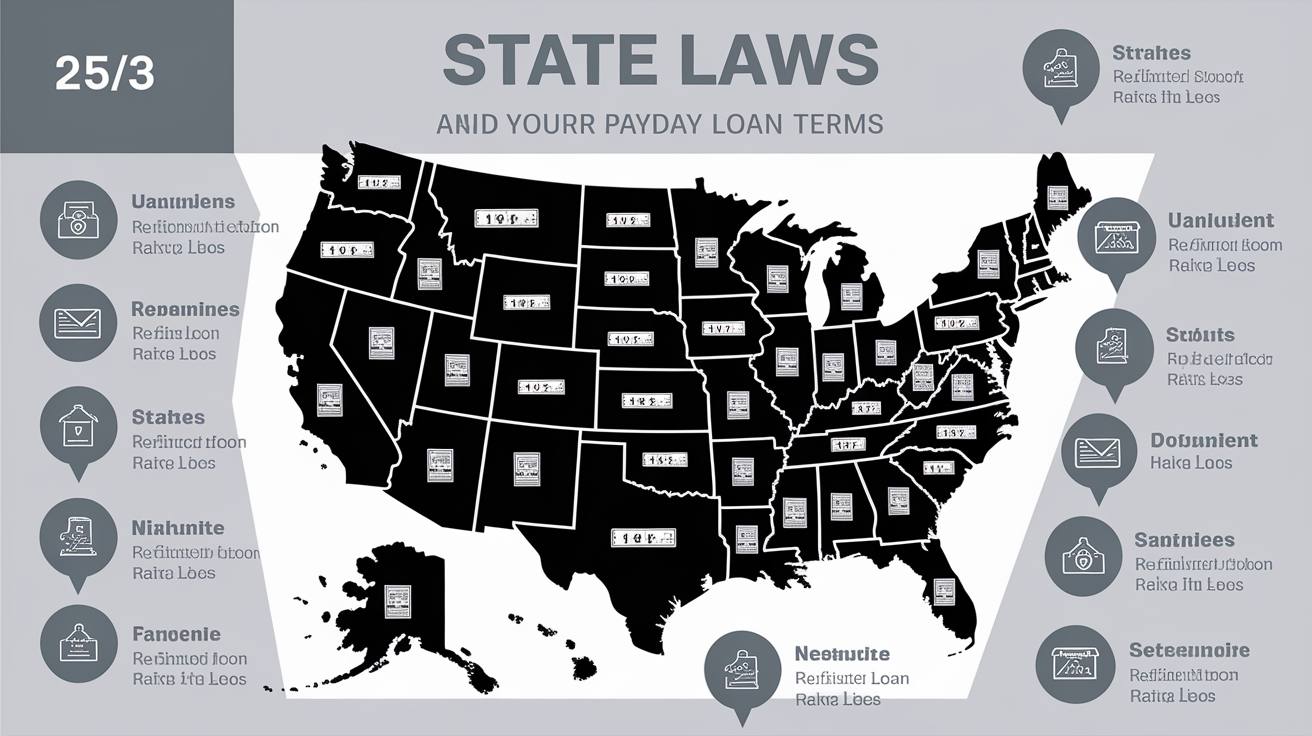
State laws can change a payday loan more than most borrowers realize. Your APR, fees, repayment window, rollover limits, and even whether the loan is allowed in your state can all shift the total cost and risk.
If you want the broader legal map first, start with the state-by-state overview; this guide stays focused on what those rules mean when you are deciding whether to borrow.
What State Law Changes First
For borrowers, the practical question is not just whether payday lending exists in your state. It is how the law changes the loan you are actually offered, because those rules can make a small loan manageable in one state and expensive or unavailable in another.
| Loan term | What state laws can control | Why it matters to you |
|---|---|---|
| Apr And Finance Charges | Interest caps, fee limits, disclosure rules, and whether certain charges are allowed | This is the biggest driver of total cost and repayment stress |
| Loan Amount | Minimum and maximum loan sizes by state | A low cap may not cover your expense; a high cap can tempt overborrowing |
| Repayment Term | Minimum and maximum time to repay, plus due-date rules | Shorter terms can raise the risk of default; longer terms can raise total cost |
| Rollovers And Renewals | Whether renewals are allowed and how many times | This affects whether a loan can snowball into repeated fees |
| Legality And Licensing | Whether payday lending is permitted, restricted, or tightly supervised | If a lender is not legal in your state, the offer itself is the red flag |
A Borrower’s Checklist Before You Sign
Read The Fee Structure
Two loans with the same principal can cost very different amounts once state-specific fees are added. If the offer is unclear, the disclosure page on federal disclosure rules is a useful companion piece.
Measure The Repayment Window
A loan that looks cheap on paper can become difficult if the term is too short. State rules on repayment periods and cooling-off gaps matter because they shape how quickly you must pay the balance back.
Ask What Happens If You Miss Due Date
Rollover rules, late penalties, and cooling-off requirements can decide whether a short-term loan stays short-term or turns into a repeated expense.
Why The Same Loan Feels Different From State To State
The biggest reason to study state law is that payday loans are not standardized nationally. One state may set a strict cap on APR, another may allow much higher rates, and a third may impose a rule that changes how the lender structures the loan altogether.
That is why comparing the loan price without checking the state rule can be misleading. A borrower might see a small dollar amount and assume the deal is fair, when the state’s fee structure or rollover policy makes the real cost much higher. If you want to estimate the final amount before you borrow, the cost calculator guide is a practical next stop.
Apr And Fee Limits
This is where state law often has the most obvious impact. Some states sharply limit the interest or fees a lender can charge; others allow far more expensive borrowing. Even when the headline loan amount looks small, a high APR can make the total repayment far larger than expected.
Loan Size And Repayment Terms
State rules may set both the smallest and largest amount you can borrow, and they may also limit how long you have to repay. That matters because a larger loan with a short term can strain your cash flow, while a smaller cap may leave you short if the emergency is bigger than the allowed amount.
Rollovers, Renewals, And Cooling-Off Periods
States use these rules to prevent repeat borrowing from turning into a debt cycle. Some places ban rollovers outright; others require a break between loans. If you want a more detailed look at how these breaks work, read the cooling-off period guide. For borrowers, the key takeaway is simple: a loan that can be renewed easily may be more expensive than it first appears.
Licensing And Enforcement
A lender’s legal status matters as much as the quoted rate. States generally require lenders to be licensed and to follow rules around disclosures, permitted charges, and collection practices. Strong enforcement can help curb abusive lending, but the quality of enforcement varies. If a lender cannot clearly explain its license and terms, that is a warning sign.
How To Compare Offers Without Getting Lost In The Fine Print
When you are comparing payday loans across states or lenders, focus on the same five details every time: APR, total fees, repayment date, rollover policy, and whether the lender is properly licensed in your state.
If one offer is more expensive but gives you a more realistic repayment window, it may still be the less risky option. On the other hand, a loan that looks flexible but charges repeated renewal fees can quickly become the costliest choice.
For borrowers who need a broader view of regulation trends, the state-by-state overview remains the best hub page, while this article is meant to help you evaluate the loan in front of you.
What To Ask Before Signing
- Is this loan legal where I live?
- What is the full dollar cost, not just the principal?
- When is it due, and can it be renewed?
- Are there penalties if I miss the deadline?
- Is there a safer alternative with a lower total cost?
Better Next Steps If The Loan Looks Expensive
If the state rules make the loan too costly, do not stop at one offer. Borrowers often compare payday loans with other emergency options, especially when fees and repayment timing start to look tight. A useful comparison path is emergency loans versus payday loans, because the right option depends on whether speed, cost, or flexibility matters most.
You can also review financial planning strategies for payday loans if you are trying to avoid repeating the same short-term borrow-and-repay cycle.
When state law allows the loan but the numbers still do not work, the safer choice is usually to pause, compare alternatives, and confirm the full repayment amount before you commit.
Choose The State Law Page Or The Cost Page Next
If you are still comparing legality and rule differences, start with the state-by-state overview. If you already know the loan is legal and want the price implications, use the cost guide to estimate what you may actually repay.
Borrowers who are unsure about licensing, disclosures, or cooling-off rules can also use the CFPB resource and the legality guide together to spot red flags before applying.
Frequently Asked Questions
What Parts Of A Payday Loan Do State Laws Affect Most?
State laws usually affect APR, fees, loan size, repayment timing, rollover options, disclosures, and whether the lender is allowed to operate in your state.
Why Can Payday Loan Costs Differ So Much Between States?
Because each state can set its own limits on interest, fees, loan amounts, and renewals, the same loan can cost far less in one state than in another.
How Do Rollover Rules Protect Borrowers?
Rollover limits and cooling-off periods reduce the chance that a short-term loan becomes a repeated cycle of fees and debt.
What Should I Check Before Applying For A Payday Loan?
Confirm legality, total cost, repayment date, renewal rules, and whether the lender is licensed where you live.
Are Payday Loans Always The Same From State To State?
No. State law can make a loan more expensive, shorter, smaller, harder to renew, or unavailable altogether.
For related reading, see the QuickLoanPro blog.

Jacob Harrison is a dynamic author specializing in a broad range of topics for QuickLoanPro. With a keen eye for detail and a passion for making financial concepts accessible, he helps readers navigate the complexities of personal finance, loans, and budgeting. Jacob’s insightful articles aim to empower individuals with the knowledge they need to make informed financial decisions, blending informative content with practical advice. Through his engaging writing style, he strives to connect with audiences, providing them with valuable resources for their financial journeys.


The variations in state regulations around payday loan interest rates truly highlight the complexity of consumer protection laws in the U.S. It’s fascinating how a borrower’s experience can differ dramatically depending on their location. For instance, in a state like New York, the cap of 25% could mean a significant difference in the financial burden one might face compared to places like Texas, where rates can soar. This divergence not only affects individuals but also shapes the lending landscape, influencing who can access funds and under what conditions.
Your exploration of state regulations and their significant impact on payday loan interest rates really hits home for me. As someone who has spent a bit of time looking into various lending practices, I’ve often found it eye-opening just how different the landscapes can be across states.
It’s great to hear that you found the exploration of state regulations about payday loans relatable. It really is fascinating how varying laws can lead to such different experiences for borrowers from one state to another. In some places, strict regulations work to protect consumers, while in others, payday loans can still carry exorbitant interest rates, really putting a strain on people who are already in tough financial spots.
It’s true that the variation in state regulations around payday loans can really impact people’s lives in significant ways. I’ve often thought about how these financial tools can be a double-edged sword. On one hand, they can provide quick cash in moments of crisis, but on the other, if the regulations aren’t stringent, the borrower can end up in a much worse financial situation due to high interest rates.
Your experience with state regulations and lending practices resonates with me too. It’s fascinating how a seemingly straightforward concept like payday lending can be so complex and varied from one state to another. For instance, I’ve noticed that some states have imposed caps on interest rates, while others have very few restrictions, leading to a kind of ‘wild west’ feel in the latter.
Your observations about payday lending and state regulations hit home. It’s true that what seems like a simple mechanism can be a complex web of rules and practices across different states. I’ve traveled through a few states with this in mind and noticed firsthand how the landscape shifts dramatically as you cross those arbitrary lines on a map.
It’s fascinating to dive into the intricate web of state regulations that influence payday loan interest rates. Your exploration of how these caps vary across the U.S. highlights a critical aspect of consumer protection that often flies under the radar. Having lived in both a state with strict regulations, like New York, and one with more lenient laws, such as Texas, I’ve directly felt the impact of these differences on borrowers.
Your insights into how state regulations shape payday loan interest rates really highlight the significant disparities across the country. It’s interesting to see how the regulatory landscape not only influences consumer costs but also reflects broader socio-economic conditions in each state. For instance, in states with stringent guidelines like New York, the focus on consumer protection seems to align with a more proactive approach to financial literacy and inclusion.
Your exploration of state regulations on payday loan interest rates sheds light on a complex issue that affects many vulnerable consumers. It’s intriguing to see how the patchwork of laws across states can lead to such different experiences for borrowers. In New York, a capped interest rate seems like a protective measure, while the leniency in places like Texas raises questions about the implications for financial wellness in communities.
This discussion on state regulations surrounding payday loan interest rates is incredibly relevant, especially considering how these loans can impact individuals’ financial health. It’s striking to see such a disparity in interest rates from one state to another. For instance, the cap in New York at 25% provides a protective measure that can help consumers avoid the trap of exorbitant debt, while the situation in Texas, where higher rates are allowed, can potentially lead borrowers into a cycle of borrowing that’s hard to escape.
You bring up such a crucial point about the disparity in payday loan interest rates across states. It’s interesting how much local legislation can shape financial landscapes and, ultimately, people’s lives. The difference in protections between states like New York and Texas really highlights how financial regulation can affect individuals’ ability to manage their debts.
This article offers a thoughtful breakdown of how upcoming shifts in payday loan apps could affect loan seekers, shedding light on factors that can help consumers make more informed choices.
‘Payday Loan Apps In 2025: What’s Changing And How To Judge Them’
https://quickloanpro.com/payday-loan-apps-future-trends-and-what-to-expect/.
It’s fascinating how state laws can significantly alter the landscape of payday loans, often in ways that aren’t immediately apparent to borrowers. For instance, in some states, the APR can soar to alarming heights, creating a burden that can spiral out of control if you’re not well-informed about the terms. In contrast, other states impose stricter regulations that can offer more protection to consumers, which is a critical factor to consider before taking out a loan.
Ah, the labyrinth of payday loans and state laws—definitely not the plot of the next big blockbuster, but it could be a fascinating drama for anyone caught in the web of financial decisions. Your breakdown on how state regulations can shift the landscape of payday loans is spot on! It’s like playing a game of Monopoly, where the rules differ depending on which piece of the board you’re on… except instead of collecting $200, you’re more likely to be dodging interest fees that could make your hair stand on end!
The insights presented in your post shed light on a critical aspect of payday loans that many tend to overlook—how state laws intricately shape the borrowing experience. As you’ve pointed out, the variations in APR, fees, and repayment terms can dramatically alter the financial landscape for borrowers.